The plan was to take an excursion to Sintra, north and west of Lisbon. There we could visit "The Moorish Castle", Pena Palace, the "Painted Castle", and the Palacia de Reguilera. I had no idea what this was about other than having seen pictures of a rather brightly colored castle and stories of the "upside down towers". Hmmm... Palacia de Reguilera seems to translate to "Palace of Joy"... and Sintra translates to "Bright Sun". It is considered something of a mystical place. It is a blend of striking natural landscape, ancient stone monuments, elaborate gardens, ancient magical forests, stunning castles and palaces, on a tall foggy mountain.
The last part of the visit, in the gardens of Palacia de Reguilera, was when it got most interesting.
... Skip around through the pictures if you must, but you must read the last two paragraphs... Most images are clickable for size. I usally just use my own images, but in some cases, I chose others to be able to do justice to the amazing places. The entire mountain, with three "castles" or "palaces", from different time periods and cultures, are set within wonderful cultural and biological gardens. They are mainly places where extremely rich people built to enjoy and entertain themselves. It's very nice.
Check here if you want to see the story of the entire Europe Trip.
There were eight of us in the van when we were picked up in the morning at our hotel. Four were from Germany. The guide, Nelson of Guia Spr Tours through Maria Ines, was a slender middle aged gent. I am grateful to him for a pretty darn interesting excursion.
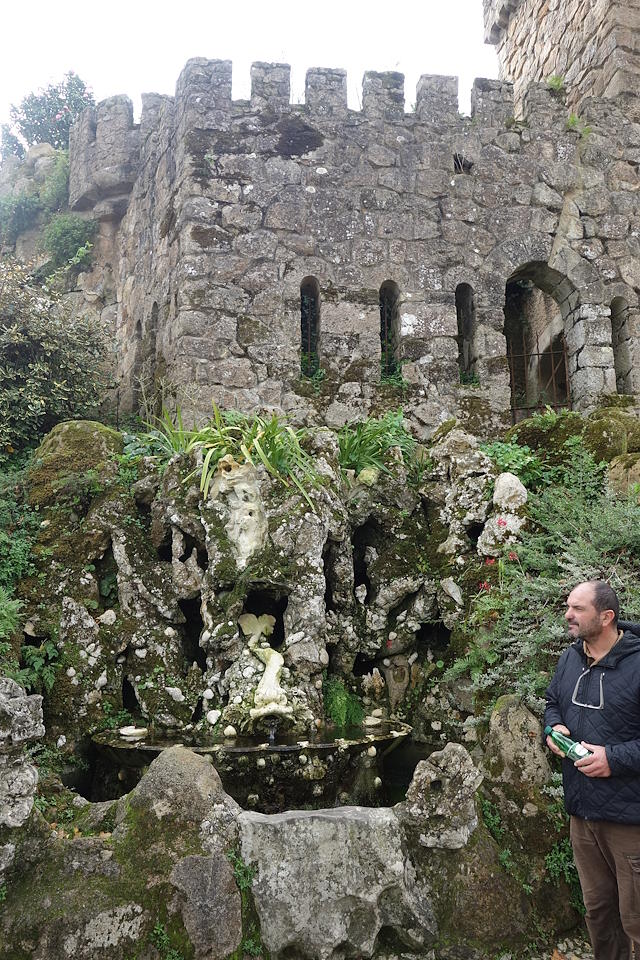 There is so much story and symbolysm, both artistic and mystical, to this fountain, and he loved to tell us about it. The sea shells are very common icons in sea faring Portugal. Click on the image to size it.
Sintra itself is a fascinating European town, showing its age with worn, moss covered stone work that is generally unfamiliar in the New World. The main landmark is two tall conical towers... that were originally chimneys for a bakery. It is an interesting walk through narrow cobble stone streets, with some pretty stately buildings. The roofs are all red tile. There was a great bell tower. What I liked most perhaps was the characteristic tile work common to Portugal. It is a cultural craft, beautiful art work, and tiles reflect heat as well. In Lisbon I saw entire building walls covered in tile. Here there were many images made of multiple tiles. It was before Christmas and there were some decorations as well as a Christmas Market, that unfortunately was not open.
Basically, the mountain with the Moorish castle, the Pena Palace, the Palacia de Reguilera, and all the many gardens
There is so much story and symbolysm, both artistic and mystical, to this fountain, and he loved to tell us about it. The sea shells are very common icons in sea faring Portugal. Click on the image to size it.
Sintra itself is a fascinating European town, showing its age with worn, moss covered stone work that is generally unfamiliar in the New World. The main landmark is two tall conical towers... that were originally chimneys for a bakery. It is an interesting walk through narrow cobble stone streets, with some pretty stately buildings. The roofs are all red tile. There was a great bell tower. What I liked most perhaps was the characteristic tile work common to Portugal. It is a cultural craft, beautiful art work, and tiles reflect heat as well. In Lisbon I saw entire building walls covered in tile. Here there were many images made of multiple tiles. It was before Christmas and there were some decorations as well as a Christmas Market, that unfortunately was not open.
Basically, the mountain with the Moorish castle, the Pena Palace, the Palacia de Reguilera, and all the many gardens
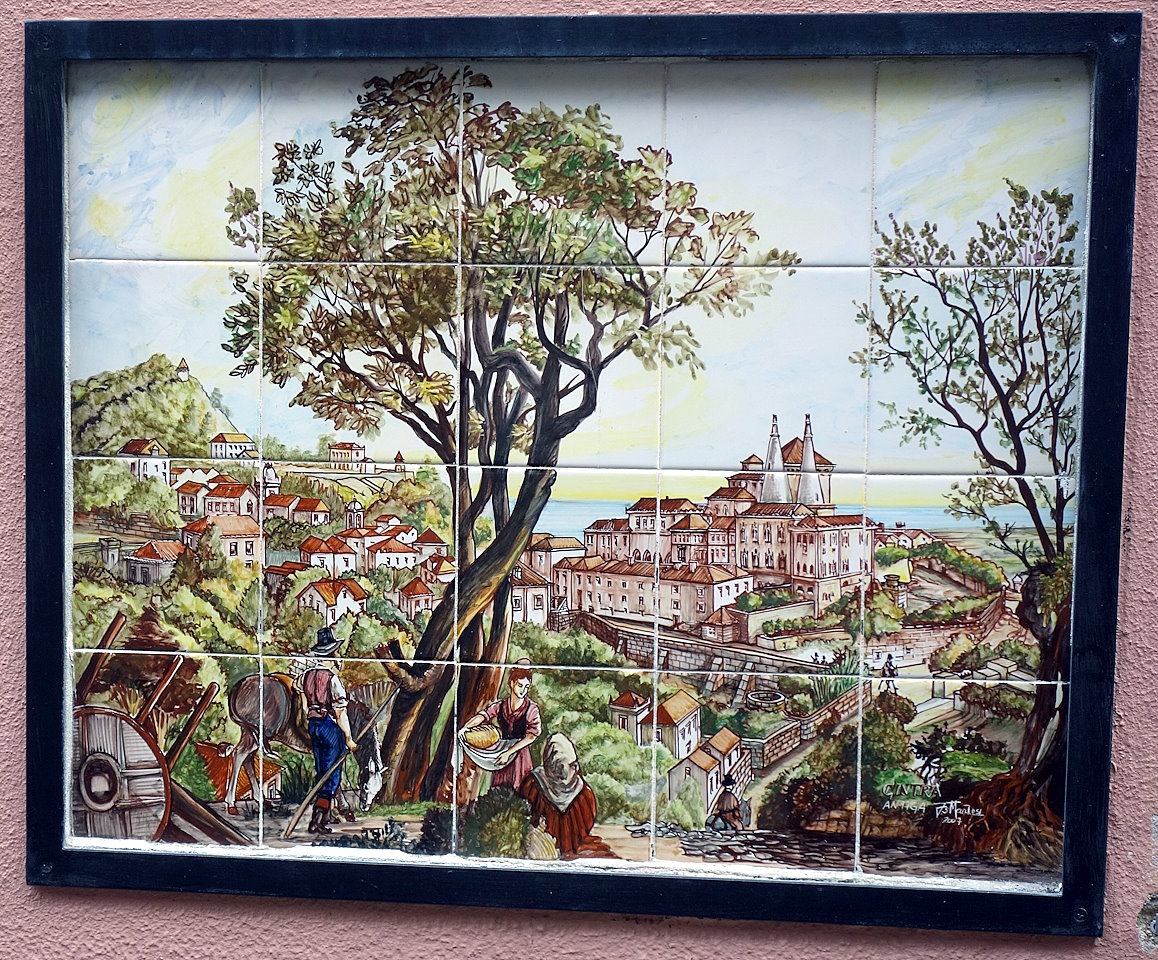 Tile Image of Sentra. Notice the two chimneys that are basically the town landmarks. Click on the image to size it.
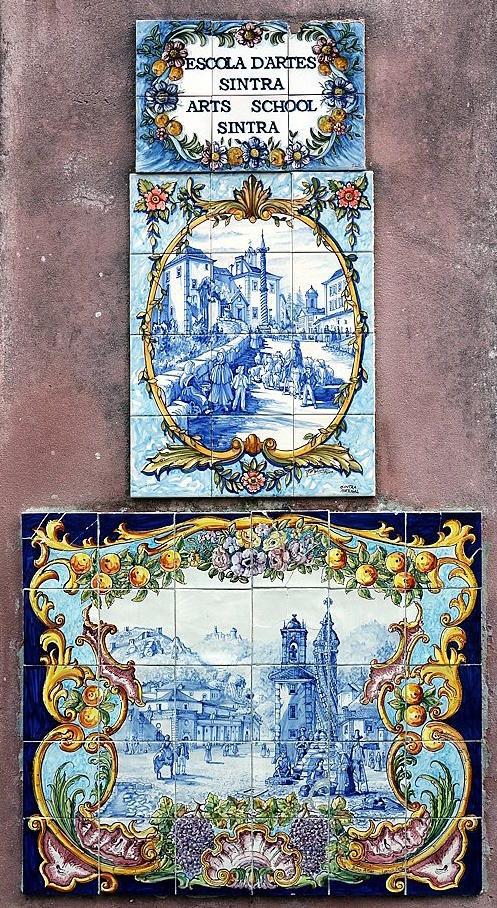 This is at the entrance to the School of Arts. In the lower tile work, you can see the Moorish Castle and the Pena Palace shown up on the hill. Click on the image to size it.
We did not stop at "The Moorish Castle". It was a military fortification for the Islamic presence in the region, and was probably constructed between the eighth and ninth centuries and later expanded after the Reconquista. It was higher on the hill and what we could see looked pretty amazing with long castle walls of stone. I cannot imagine the labor, both human and animal needed to do the stone work, and to bring building materials and supplies up the rather substantial mountain.
Most of the way up the hill is the Pena Palace, that apparently started as a sixteenth century monastery. Lightning, and then the 1755 Lisbon earthquake, occurring shortly afterwards, mostly reduced the monastery to ruins. In 1838, King consort Ferdinand II acquired all the land in the area and had it rebuilt, mostly in Romantic style, as a Summer Palace. It actually has many styles in parts, including Victorian and Edwardian styles. It's quite the a castle, but it was never meant for war. It is still used for State Events. The surroundings are beautifully forested, with trees from many continents. From the Castle, you can see the ocean about 6 miles away.
This is at the entrance to the School of Arts. In the lower tile work, you can see the Moorish Castle and the Pena Palace shown up on the hill. Click on the image to size it.
We did not stop at "The Moorish Castle". It was a military fortification for the Islamic presence in the region, and was probably constructed between the eighth and ninth centuries and later expanded after the Reconquista. It was higher on the hill and what we could see looked pretty amazing with long castle walls of stone. I cannot imagine the labor, both human and animal needed to do the stone work, and to bring building materials and supplies up the rather substantial mountain.
Most of the way up the hill is the Pena Palace, that apparently started as a sixteenth century monastery. Lightning, and then the 1755 Lisbon earthquake, occurring shortly afterwards, mostly reduced the monastery to ruins. In 1838, King consort Ferdinand II acquired all the land in the area and had it rebuilt, mostly in Romantic style, as a Summer Palace. It actually has many styles in parts, including Victorian and Edwardian styles. It's quite the a castle, but it was never meant for war. It is still used for State Events. The surroundings are beautifully forested, with trees from many continents. From the Castle, you can see the ocean about 6 miles away.
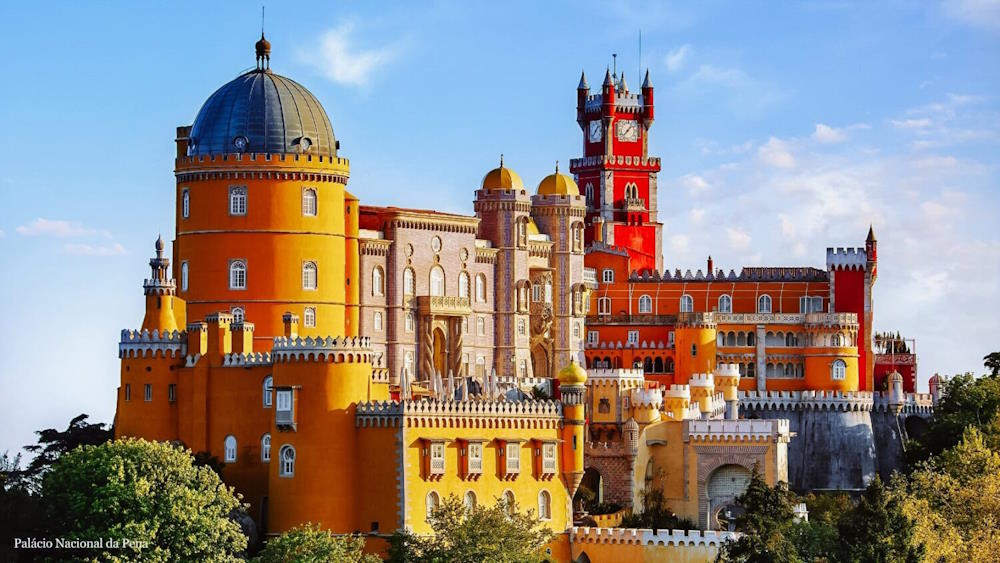 Pena Palace - Palácio Nacional da Pena, was basically a summer home. Click on the image to size it.
It's a lot cooler there in Summer than much of Portugal or many places in Europe, so a lot of royalty used to like spending time there in Summer.
Pena Palace - Palácio Nacional da Pena, was basically a summer home. Click on the image to size it.
It's a lot cooler there in Summer than much of Portugal or many places in Europe, so a lot of royalty used to like spending time there in Summer.
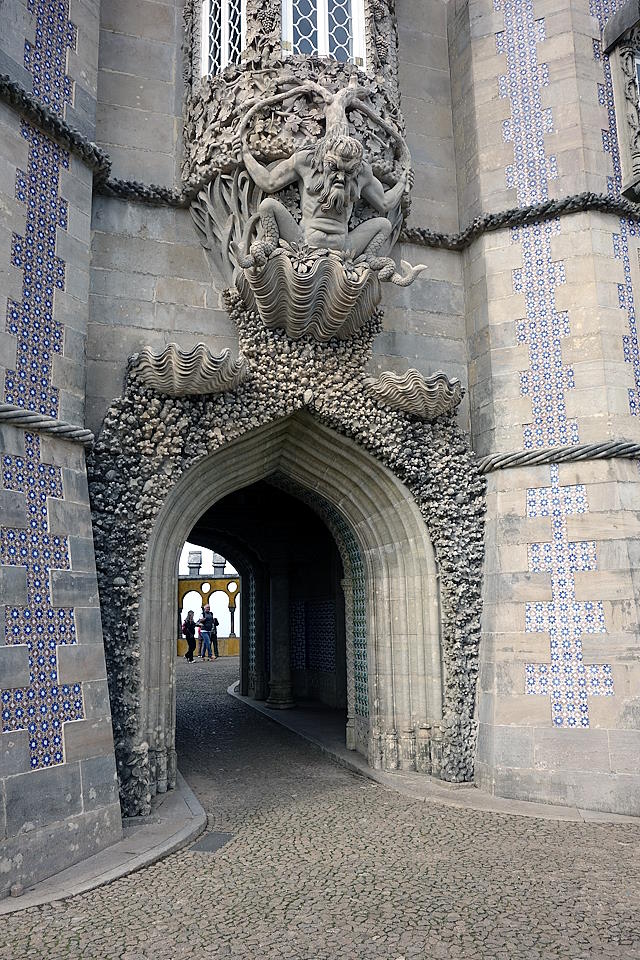 Tiled Archway at Pena Palace. Notice the nautical theme so common to Portugal. Click on the image to size it.
To me, the most interesting part and why I went to the effort of writing this is the Palacia de Reguilera. Very loosely speaking it is a large garden. The main palace, Quinta da Regaleira, the Manor House (if I've got it right), is this beautiful building with slender Manueline-Gothic spires. Its stone walls are half hidden by the surrounding greenery. I'm pretty sure that it dates back to the sixteenth century. I toured the bottom floor and was reminded of Hearst Castle. I'm very sure "The Chief" William Randolf Hearst and Julia Morgan had visited there. Very beautiful in so many ways.
Tiled Archway at Pena Palace. Notice the nautical theme so common to Portugal. Click on the image to size it.
To me, the most interesting part and why I went to the effort of writing this is the Palacia de Reguilera. Very loosely speaking it is a large garden. The main palace, Quinta da Regaleira, the Manor House (if I've got it right), is this beautiful building with slender Manueline-Gothic spires. Its stone walls are half hidden by the surrounding greenery. I'm pretty sure that it dates back to the sixteenth century. I toured the bottom floor and was reminded of Hearst Castle. I'm very sure "The Chief" William Randolf Hearst and Julia Morgan had visited there. Very beautiful in so many ways.
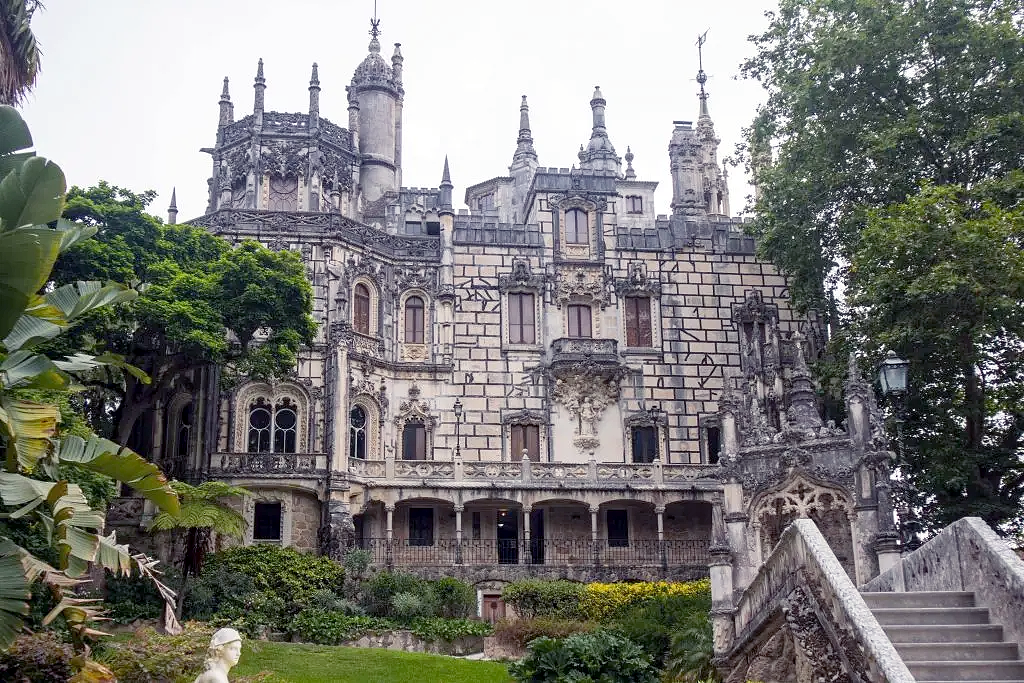 Palacia de Reguilera. Click on the image to size it.
They say it is an enchanted castle in an magical forest. No matter what, the gardens and forest would qualify as very beautiful, but the garden is full of art, grottos, tunnels, "upside down towers" and mystic symbolism. This was also the most fascinating part to the guide and he tried to convey to us what it was about. The garden was built at the very start of the 20th century. The architect was Luigi Manini. It is a bit like a mature, more expensive and thoughtful version of Parc Güell in Barcelona, designed by Antoni Gaudí and there are some connections in the mysticism, especially the "underground waters" symbolized by the "iguana" in Parc Güell.
The views from Quinta da Regaleira of the Moorish Castle and Pena Palace are better than the views from those two places.
Palacia de Reguilera. Click on the image to size it.
They say it is an enchanted castle in an magical forest. No matter what, the gardens and forest would qualify as very beautiful, but the garden is full of art, grottos, tunnels, "upside down towers" and mystic symbolism. This was also the most fascinating part to the guide and he tried to convey to us what it was about. The garden was built at the very start of the 20th century. The architect was Luigi Manini. It is a bit like a mature, more expensive and thoughtful version of Parc Güell in Barcelona, designed by Antoni Gaudí and there are some connections in the mysticism, especially the "underground waters" symbolized by the "iguana" in Parc Güell.
The views from Quinta da Regaleira of the Moorish Castle and Pena Palace are better than the views from those two places.
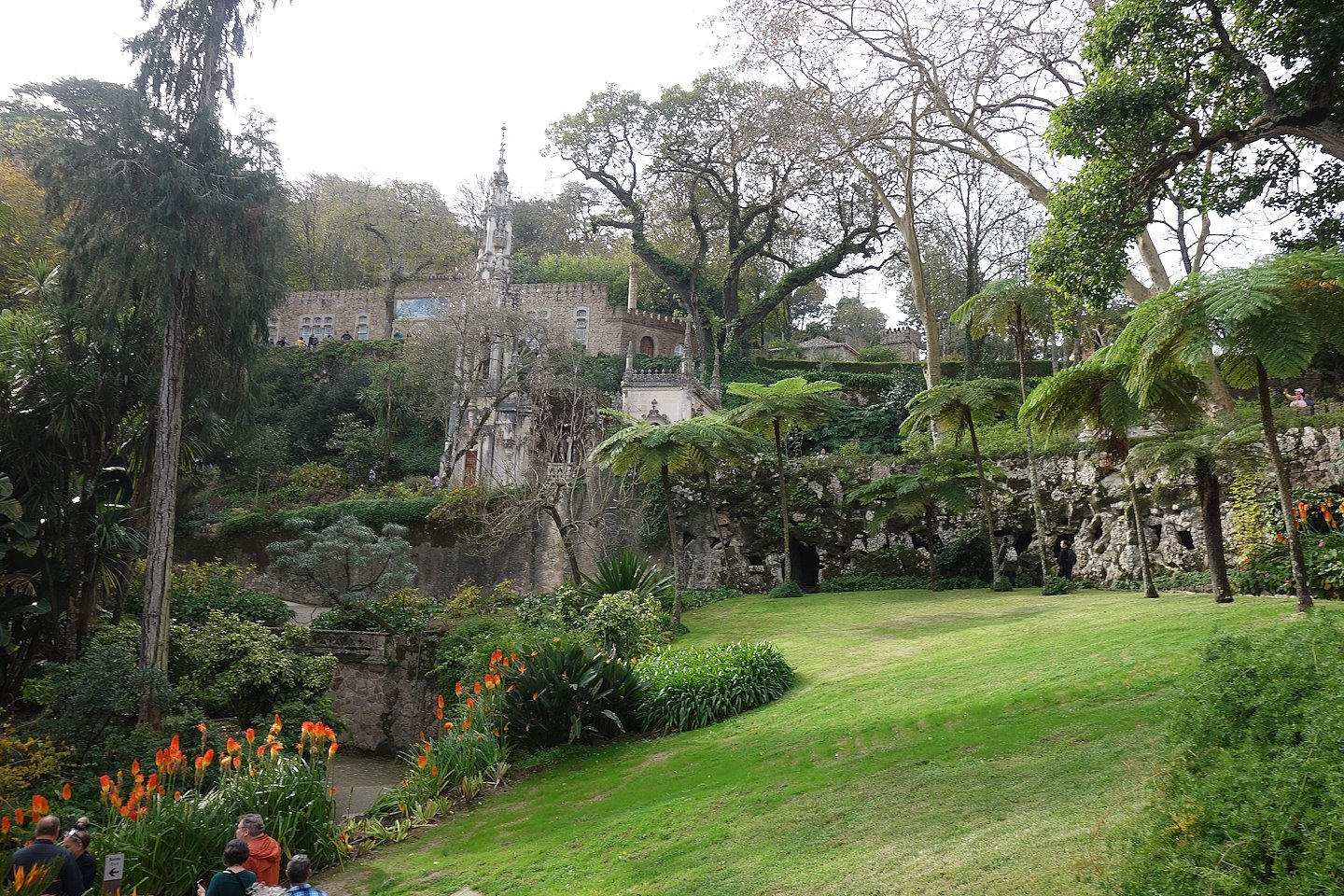 A Beautiful Garden of Quinta da Regaleira. Click on the image to size it.
Quinta da Regaleira is famous for its unique blend of architectural styles, underground tunnels and esoteric symbolism. It has beautiful gardens in a gothic / sublime style with hidden paths grottos and underground passages. Nice cafe. House is completely over the top gothic style. There are whimsical toy castles... 40 feet or so tall. There is the completely over the top Gothic Chapel, but it was in the gardens that interested me.
A Beautiful Garden of Quinta da Regaleira. Click on the image to size it.
Quinta da Regaleira is famous for its unique blend of architectural styles, underground tunnels and esoteric symbolism. It has beautiful gardens in a gothic / sublime style with hidden paths grottos and underground passages. Nice cafe. House is completely over the top gothic style. There are whimsical toy castles... 40 feet or so tall. There is the completely over the top Gothic Chapel, but it was in the gardens that interested me.
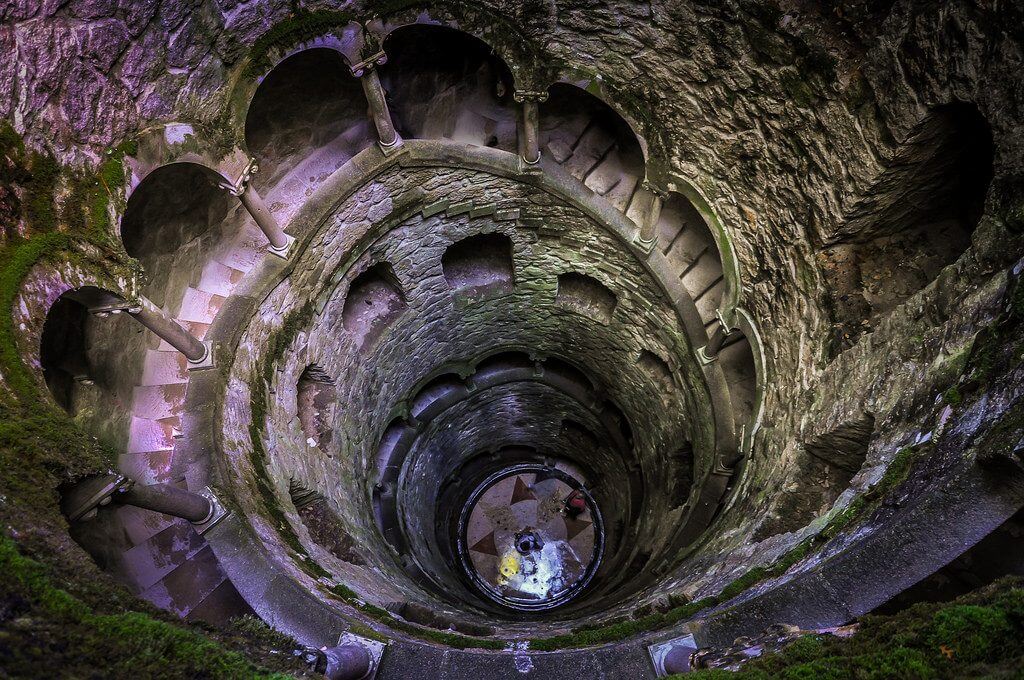 Upside Down Tower. It symbolizes a descent into the depths of knowledge and self discovery. When you reach the bottom, you exit through a cave that represents the birth and emergence of knowledge. Click on the image to size it.
The owner of Quinta da Regaleira at the turn of the century and his architect were both Renaissance men. The were highly educated and cosmopolitan, but this was before World War I showed the power and wealth of science. Science was very new and limited then. An educated person of the time might know some science then, but they might also be very familiar with astrology, numerology, spiritualism and even alchemy. Throw in some Knights Templer for good luck. This was a time when many people saw the world as a place with the material world and the spiritual world as adjacent. The garden is a celebration of many beliefs of the time. For example, the Masonic symbols found throughout Quinta da Regaleira are believed to represent different aspects of Freemasonry and its teachings. These symbols include the compass, the square, the pentagram, and the all-seeing eye. There is the beautiful grotto you can walk into that represents the waters of the underworld. here are small paths through the garden, just inviting you to wander them. The Initiation Well, often called "the upside down tower", has 177 steps, as did the stair down to hell in Dante's story. There many sculptures and fountains, many with seashells or birds or lizards. There are ropes and knots, representing Portugal's nautical past.
Upside Down Tower. It symbolizes a descent into the depths of knowledge and self discovery. When you reach the bottom, you exit through a cave that represents the birth and emergence of knowledge. Click on the image to size it.
The owner of Quinta da Regaleira at the turn of the century and his architect were both Renaissance men. The were highly educated and cosmopolitan, but this was before World War I showed the power and wealth of science. Science was very new and limited then. An educated person of the time might know some science then, but they might also be very familiar with astrology, numerology, spiritualism and even alchemy. Throw in some Knights Templer for good luck. This was a time when many people saw the world as a place with the material world and the spiritual world as adjacent. The garden is a celebration of many beliefs of the time. For example, the Masonic symbols found throughout Quinta da Regaleira are believed to represent different aspects of Freemasonry and its teachings. These symbols include the compass, the square, the pentagram, and the all-seeing eye. There is the beautiful grotto you can walk into that represents the waters of the underworld. here are small paths through the garden, just inviting you to wander them. The Initiation Well, often called "the upside down tower", has 177 steps, as did the stair down to hell in Dante's story. There many sculptures and fountains, many with seashells or birds or lizards. There are ropes and knots, representing Portugal's nautical past.
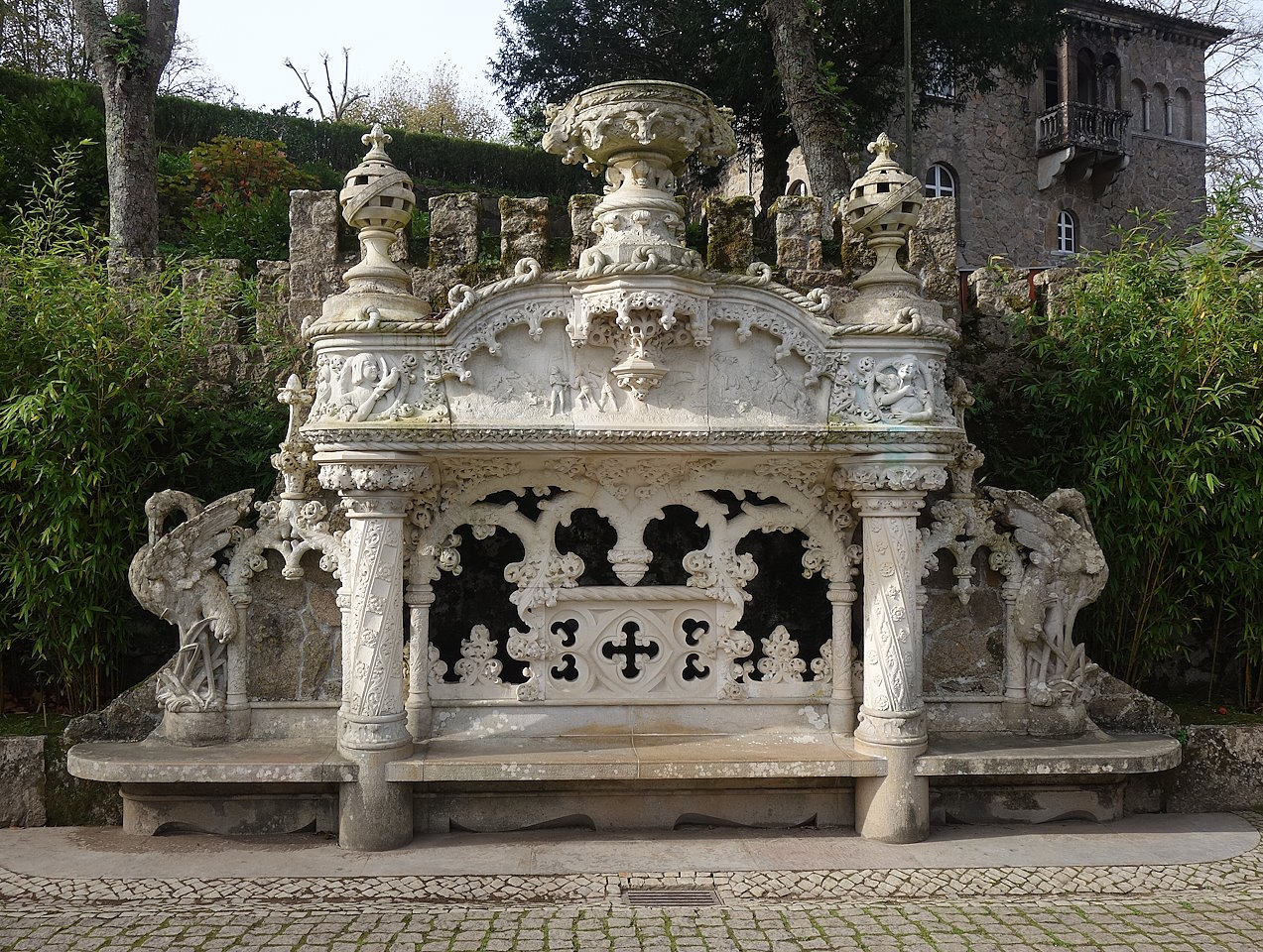 There are many sculptures like this in the gardens. Look at the detailed story it tells. Again you see the rope iconography and other symbols. Click on the image to size it.
It gets more interesting though, as our guide explained. The vast garden is about the emergence of ideas and understandings. The caves, as many things in the garden, represent more than just one thing, but one thing they do represent is birth, especially of enlightenment. The gardens are now popular and busy. They are really meant though to be seen alone with your thoughts, or maybe with a contemplative book, or maybe with the intoxicant of your choice. They are meant to inspire thought, but even more than that they are meant as a place where thoughts can be completed, and understandings emerge. Definitly one of the coolest places I've ever been!
I highly recommend a 6 minute video about it. QUINTA DA REGALEIRA: A Mystic’s Paradise | Sintra, Portugal. Sintra is one of the most interesting places you could visit.
There are many sculptures like this in the gardens. Look at the detailed story it tells. Again you see the rope iconography and other symbols. Click on the image to size it.
It gets more interesting though, as our guide explained. The vast garden is about the emergence of ideas and understandings. The caves, as many things in the garden, represent more than just one thing, but one thing they do represent is birth, especially of enlightenment. The gardens are now popular and busy. They are really meant though to be seen alone with your thoughts, or maybe with a contemplative book, or maybe with the intoxicant of your choice. They are meant to inspire thought, but even more than that they are meant as a place where thoughts can be completed, and understandings emerge. Definitly one of the coolest places I've ever been!
I highly recommend a 6 minute video about it. QUINTA DA REGALEIRA: A Mystic’s Paradise | Sintra, Portugal. Sintra is one of the most interesting places you could visit.
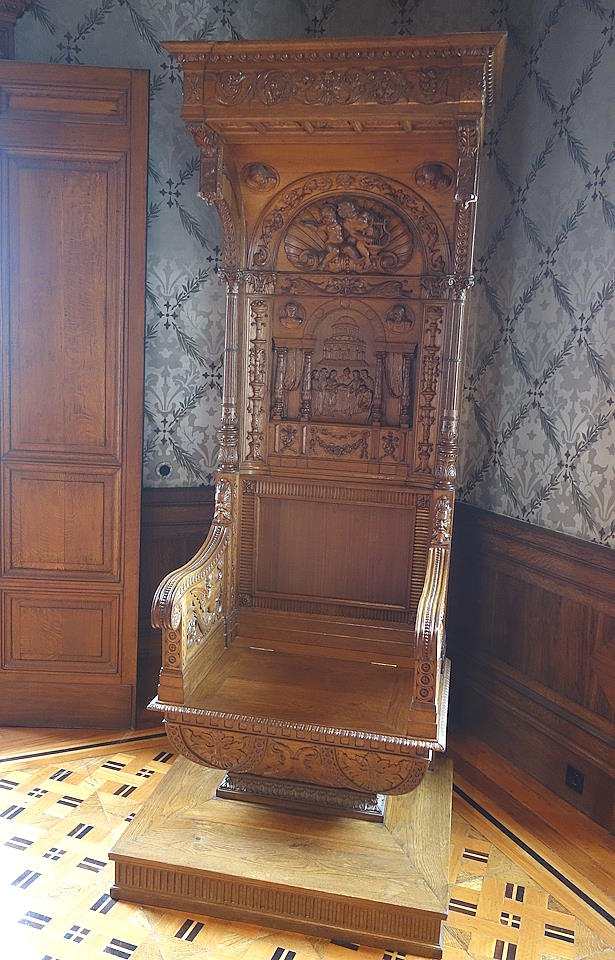 Throne of Quinta da Regaleira. Click on the image to size it.